2022-04-15 Fri
pub data seismic
Our project published the following unclassified unlimited release (UUR) paper.
Abstract
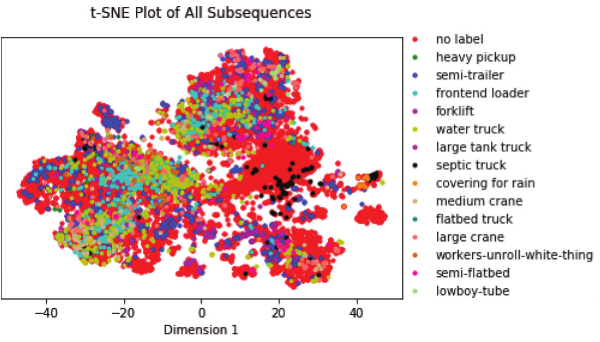
Pattern-of-life analysis models the observable activities associated with a particular entity or location over time. Automatically finding and separating these activities from noise and other background activity presents a technical challenge for a variety of data types and sources. This paper investigates a framework for finding and separating a variety of vehicle activities recorded using seismic sensors situated around a construction site. Our approach breaks the seismic waveform into segments, preprocesses them, and extracts features from each. We then apply feature scaling and dimensionality reduction algorithms before clustering and visualizing the data. Results suggest that the approach effectively separates the use of certain vehicle types and reveals interesting distributions in the data. Our reliance on unsupervised machine learning algorithms suggests that the approach can generalize to other data sources and monitoring contexts. We conclude by discussing limitations and future work.
Publication
2021-10-12 Tue
smartnic faodel hpc
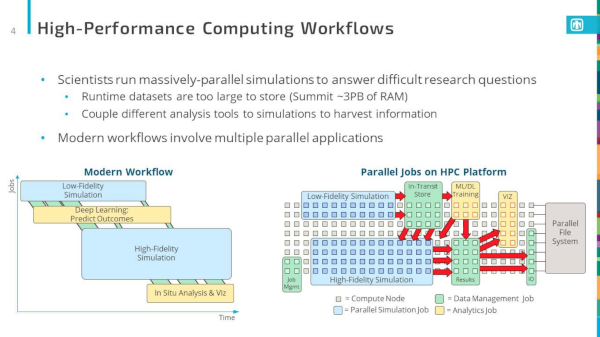
Our ASCR SmartNIC project gave the following unclassified unlimited release (UUR) talk.
Presentation
2021-10-08 Fri
faodel code
We received DOE approval to relase version 1.2108.1 ("Fluid") of FAODEL on Github.

A Real-life Faodhail
2021-05-14 Fri
net smartnic pub
Our ASCR project published an unclassified unlimited release (UUR) report on arXiv.
Abstract
High-performance computing (HPC) researchers have long envisioned scenarios where application workflows could be improved through the use of programmable processing elements embedded in the network fabric. Recently, vendors have introduced programmable Smart Network Interface Cards (SmartNICs) that enable computations to be offloaded to the edge of the network. There is great interest in both the HPC and high-performance data analytics communities in understanding the roles these devices may play in the data paths of upcoming systems.
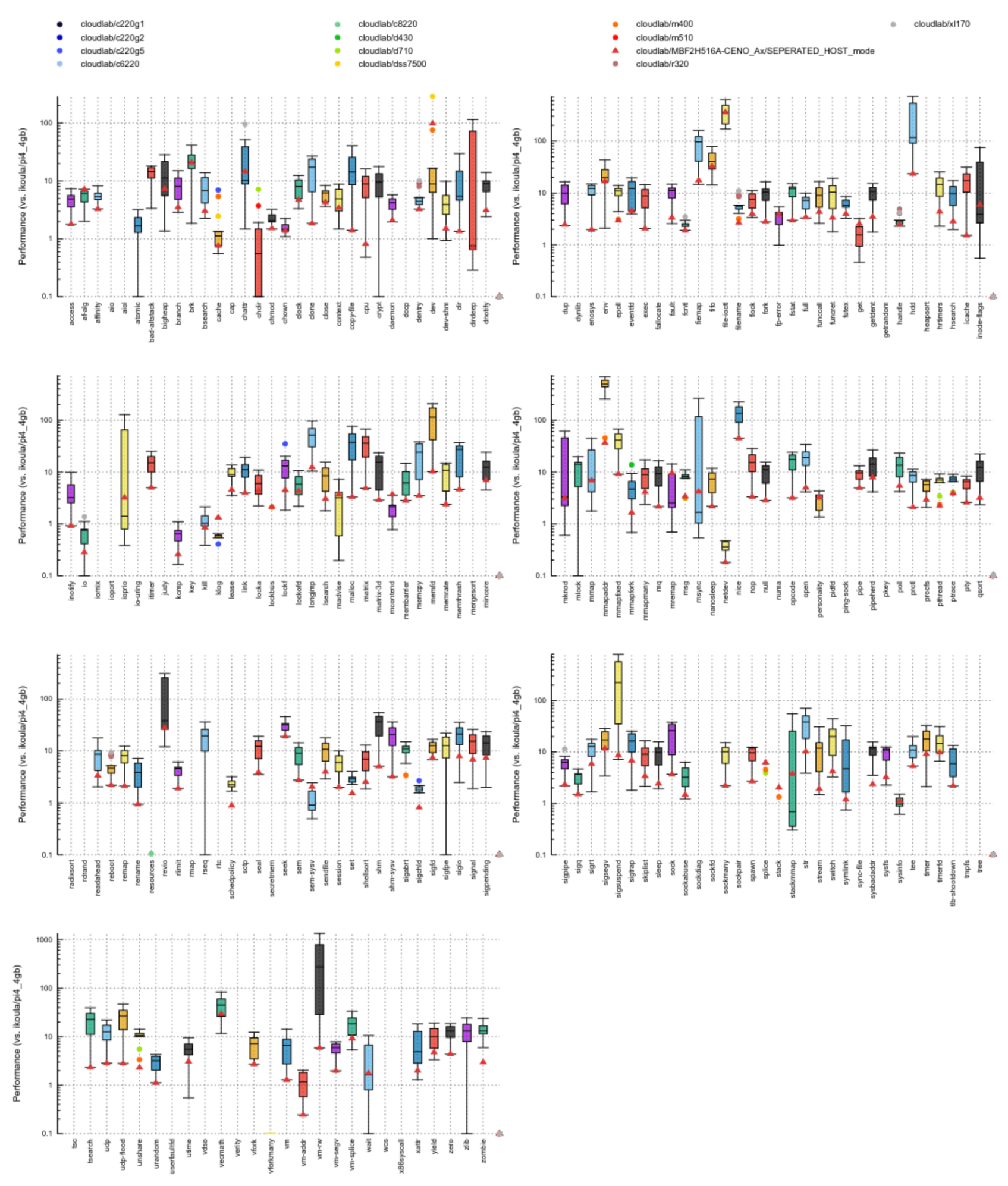
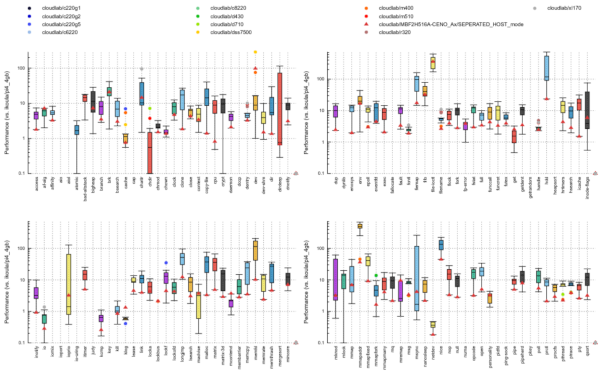
This paper focuses on characterizing both the networking and computing aspects of NVIDIA's new BlueField-2 SmartNIC when used in an Ethernet environment. For the networking evaluation we conducted multiple transfer experiments between processors located at the host, the SmartNIC, and a remote host. These tests illuminate how much processing headroom is available on the SmartNIC during transfers. For the computing evaluation we used the stress-ng benchmark to compare the BlueField-2 to other servers and place realistic bounds on the types of offload operations that are appropriate for the hardware.
Our findings from this work indicate that while the BlueField-2 provides a flexible means of processing data at the network's edge, great care must be taken to not overwhelm the hardware. While the host can easily saturate the network link, the SmartNIC's embedded processors may not have enough computing resources to sustain more than half the expected bandwidth when using kernel-space packet processing. From a computational perspective, encryption operations, memory operations under contention, and on-card IPC operations on the SmartNIC perform significantly better than the general-purpose servers used for comparisons in our experiments. Therefore, applications that mainly focus on these operations may be good candidates for offloading to the SmartNIC.
Publication
- arXiv-2105.06619 Jianshen Liu, Carlos Maltzahn, Craig Ulmer, and Matthew Curry, "Performance Characteristics of the BlueField-2 SmartNIC" arXiv-2105.06619, May 2021.
2021-02-03 Wed
hpc gpu pub
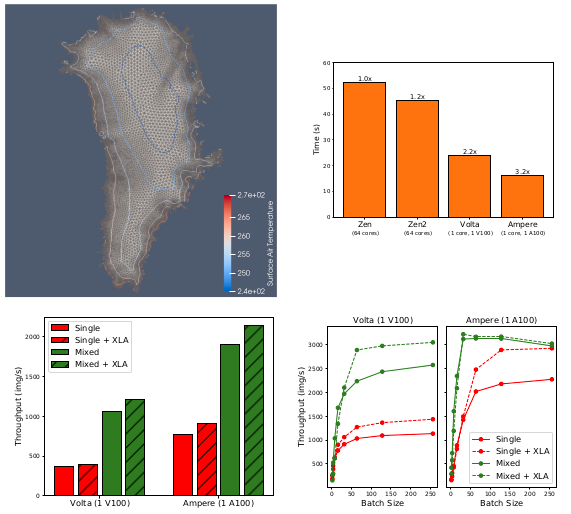
We published an unclassified unlimited release (UUR) technical report.
Abstract
The performance of NVIDIA's latest A100 graphics processing unit (GPU) is benchmarked for computing and data analytic workloads relevant to Sandia's missions. The A100 is compared to previous generations of GPUs, including the V100 and K80, as well as multi-core CPUs from two generations of AMD's EPYC processors, Zen and Zen 2. Computing workloads such as sparse matrix operations (e.g. HPCG benchmark) and numerical solver-heavy applications based on Trilinos and Kokkos see a moderate 1.5x to 2x speedups compared to the V100, consistent with the increased core count and memory bandwidth of the A100. Training and inference on machine learning (ML) models such as ResNet-50 for image classification and BERT-Large for natural language processing show the same 2x speedup over the V100.
However, these ML workloads also benefit from increased tensor core capabilities in the V100 and A100 GPUs, yielding a 3.5x speedup using a mixed (single + half) precision strategy for floating point operations. While the performance gap between GPUs and CPUs remains moderate (3x to 8x) for high-performance computing applications, these new hardware features of recent GPU generations give 50x to 100x speedups in out-of-the-box ML workloads compared to CPUs. With additional A100 features still undergoing testing (INT8, structural sparsity, multi-instance GPUs) with clear applications for ML workloads, the A100 GPU seems an extremely promising hardware accelerator for artificial intelligence (AI) and data analytics research at Sandia.
Publication
- SAND Report Stefan Seritan and Craig Ulmer "Benchmarking the NVIDIA A100 Graphics Processing Unit for High-Performance Computing and Data Analytics Workloads". SAND2021-1220, February 2021.