We published an unclassified unlimited release (UUR) paper.
Abstract
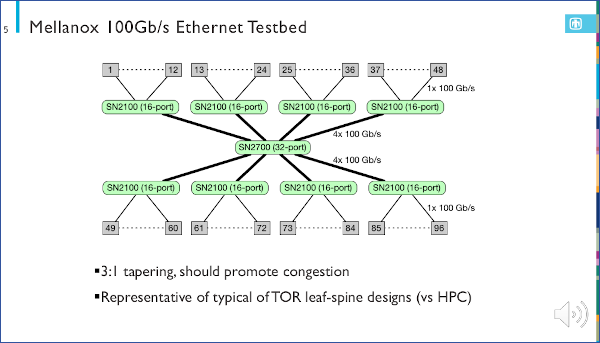
Priority-based Flow Control (PFC), RDMA over Converged Ethernet (RoCE) and Enhanced Transmission Selection (ETS) are three enhancements to Ethernet networks which allow increased performance and may make Ethernet attractive for systems supporting a diverse scientific workload. We constructed a 96-node testbed cluster with a 100 Gb/s Ethernet network configured as a tapered fat tree. Tests representing important network operating conditions were completed and we provide an analysis of these performance results. RoCE running over a PFC-enabled network was found to significantly increase performance for both bandwidth-sensitive and latency-sensitive applications when compared to TCP. Additionally, a case study of interfering applications showed that ETS can prevent starvation of network traffic for latency-sensitive applications running on congested networks. We did not encounter any notable performance limitations for our Ethernet testbed, but we found that practical disadvantages still tip the balance towards traditional HPC networks unless a system design is driven by additional external requirements.
Publication
- INDIS2020 Paper Joseph P. Kenny, Jeremiah J. Wilke, Craig D. Ulmer, Gavin M. Baker, Samuel Knight, and Jerrold A. Friesen, "An Evaluation of Ethernet Performance for Scientific Workloads". in 2020 IEEE/ACM Innovating the Network for Data-Intensive Science (INDIS).
Presentation
2020-08-01 Sat
faodel hpc io pub
We published an unclassified unlimited release (UUR) technical report.
Publications
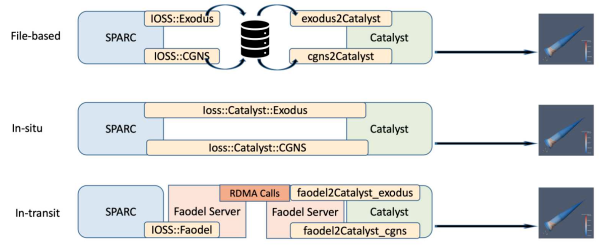
- SAND Report Gary Templet et. al., "Data Services for Visualization and Analysis - ASC Level II Milestone (7186)" SAND2020-9451
We published an unclassified unlimited release (UUR) paper.
Abstract
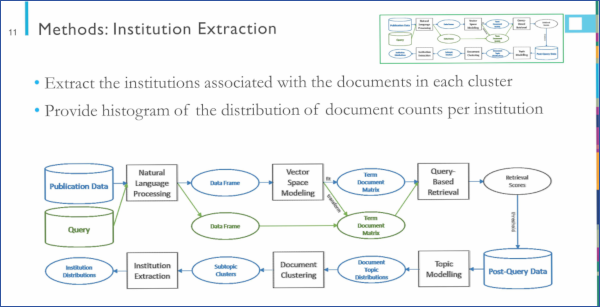
Scientific and technical publications can provide relevant information regarding the technical capabilities of a state, the location of nuclear materials and related research activities within that state, and international partnerships and collaborations. Nuclear proliferation analysts monitor scientific and technical publications using complex word searches defined by fuel cycle experts as part of their collection and analysis of all potentially relevant information. These search strings have been refined over time by fuel cycle experts and other analysts but represent a top-down approach that is inherently defined by the requirement of term presence. In contrast, we are developing a bottom-up approach in which we develop topic models from a small number of expert refereed source documents to search similar topic space, with the hope that we can use this method to identify publications that are relevant to the proliferation detection problems space without necessarily conforming to the expert-derived rule base. We are comparing our results of various topic modeling and clustering techniques to a traditional analyst search strings to determine how well our methods work to find seed documents. We also present how our methods provide added benefit over traditional search by organizing the retrieved documents into topic-oriented clusters. Finally, we present distributions of author institutions to facilitate a broader perspective of the content of interest for analysts.
Publications
- INMM Paper Jonathan Bisila, Daniel M. Dunlavy, Zoe N. Gastelum, and Craig D. Ulmer, "Topic Modeling with Natural Language Processing for Identification of Nuclear Proliferation-Relevant Scientific and Technical Publications", in Proceedings of the Institute of Nuclear Materials Management (INMM) 61st Annual Meeting, July 12, 2020.
Presentations
- INMM Slides Presentation that Jon gave virtually at INMM.
2020-05-28 Thu
faodel net pub
We published an unclassified unlimited release (UUR) paper.
Abstract
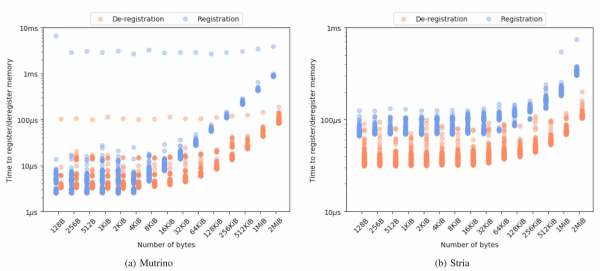
Remote Direct Memory Access (RDMA) is an increasingly important technology in high-performance computing (HPC). RDMA provides low-latency, high-bandwidth data transfer between compute nodes. Additionally, it does not require explicit synchronization with the destination processor. Eliminating unnecessary synchronization can significantly improve the communication performance of large-scale scientific codes. A long-standing challenge presented by RDMA communication is mitigating the cost of registering memory with the network interface controller (NIC). Reusing memory once it is registered has been shown to significantly reduce the cost of RDMA communication. However, existing approaches for reusing memory rely on implicit memory semantics. In this paper, we introduce an approach that makes memory reuse semantics explicit by exposing a separate allocator for registered memory. The data and analysis in this paper yield the following contributions: (i) managing registered memory explicitly enables efficient reuse of registered memory; (ii) registering large memory regions to amortize the registration cost over multiple user requests can significantly reduce cost of acquiring new registered memory; and (iii) reducing the cost of acquiring registered memory can significantly improve the performance of RDMA communication. Reusing registered memory is key to high-performance RDMA communication. By making reuse semantics explicit, our approach has the potential to improve RDMA performance by making it significantly easier for programmers to efficiently reuse registered memory.
Publication
- IPDPSW Paper Scott Levy, Patrick Widener, Craig Ulmer, and Todd Kordenbrock, "The Case for Explicit Reuse Semantics for RDMA Communication", 2020 IEEE International Parallel and Distributed Processing Symposium Workshops (IPDPSW) pp 879-888. DOI:10.1109/IPDPSW50202.2020.00148
2019-12-01 Sun
hpc io faodel pub
We published an unclassified unlimited release (UUR) paper.
Abstract
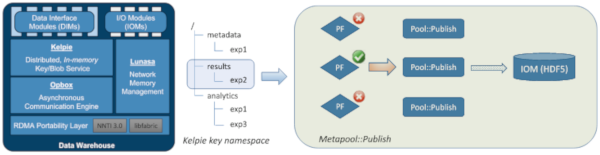
Composition of computational science applications into both ad hoc pipelines for analysis of collected or generated data and into well-defined and repeatable workflows is becoming increasingly popular. Meanwhile, dedicated high performance computing storage environments are rapidly becoming more diverse, with both significant amounts of non-volatile memory storage and mature parallel file systems available. At the same time, computational science codes are being coupled to data analysis tools which are not filesystem-oriented. In this paper, we describe how the FAODEL data management service can expose different available data storage options and mediate among them in both application- and FAODEL-directed ways. These capabilities allow applications to exploit their knowledge of the different types of data they may exchange during a workflow execution, and also provide FAODEL with mechanisms to proactively tune data storage behavior when appropriate. We describe the implementation of these capabilities in FAODEL and how they are used by applications, and present preliminary performance results demonstrating the potential benefits of our approach.
Publications
- ISC HP Paper Patrick Widener, Craig Ulmer, Scott Levy, Todd Kordenbrock, and Gary Templet, "Mediating Data Center Storage Diversity in HPC Applications with FAODEL", ISC High Performance 2019. Lecture Notes in Computer Science, vol 11887.
Presentations